
Lab Billing Made Simple: What Impacts Your Reimbursements

Did you know? You can technically deliver the right lab results, but still lose revenue. Reimbursement hinges on three factors: coverage, correct documentation, and payer network status. Fail one, and payment is reduced, delayed, or denied.
In fact, a study found that the processes laboratories use to seek reimbursement for services performed are complex and often unclear to laboratorians. And yet, they make daily testing decisions that directly affect billing—and most learn these financial rules only on the job.
In this article, we’re demystifying laboratory reimbursement by breaking it down into a clear, step-by-step framework, while highlighting common pitfalls and the root causes behind frequent reimbursement errors, so your bottom line reflects the hard work you’re doing.
Key Takeaways
What is lab reimbursement?
According to the American Clinical Laboratory Association (ACLA), clinical laboratories are reimbursed for services to Medicare beneficiaries under either the Physician Fee Schedule (PFS) or the Clinical Laboratory Fee Schedule (CLFS), depending on the service. In short, reimbursement is how the lab gets paid for the work it does, and the amount depends on the test, coverage rules, coding, and negotiated rates.
Protecting Access to Medicare Act (PAMA)-driven reductions can reach up to 15% per year for many lab tests, with the cuts compounding over multiple years.
American Society for Clinical Laboratory Science (ASCLS) reports that nearly $4 billion in cuts had already occurred by 2022, exceeding the original projected savings.
Starting in February, a current law will require labs to report to Medicare the rates private insurers paid for tests in 2019. Medicare will then cut its own test payments to those levels in 2027.
That’s why it’s vital that you understand the common pitfalls of delayed or denied reimbursements, their impact, and how to mitigate the errors before it’s too late.
The lab reimbursement cycle
Remember this: The laboratory reimbursement cycle affects cash flow, denial rates, and the speed at which a lab converts work into revenue. Below is a simple flowchart detailing each step involved in processing a reimbursement.
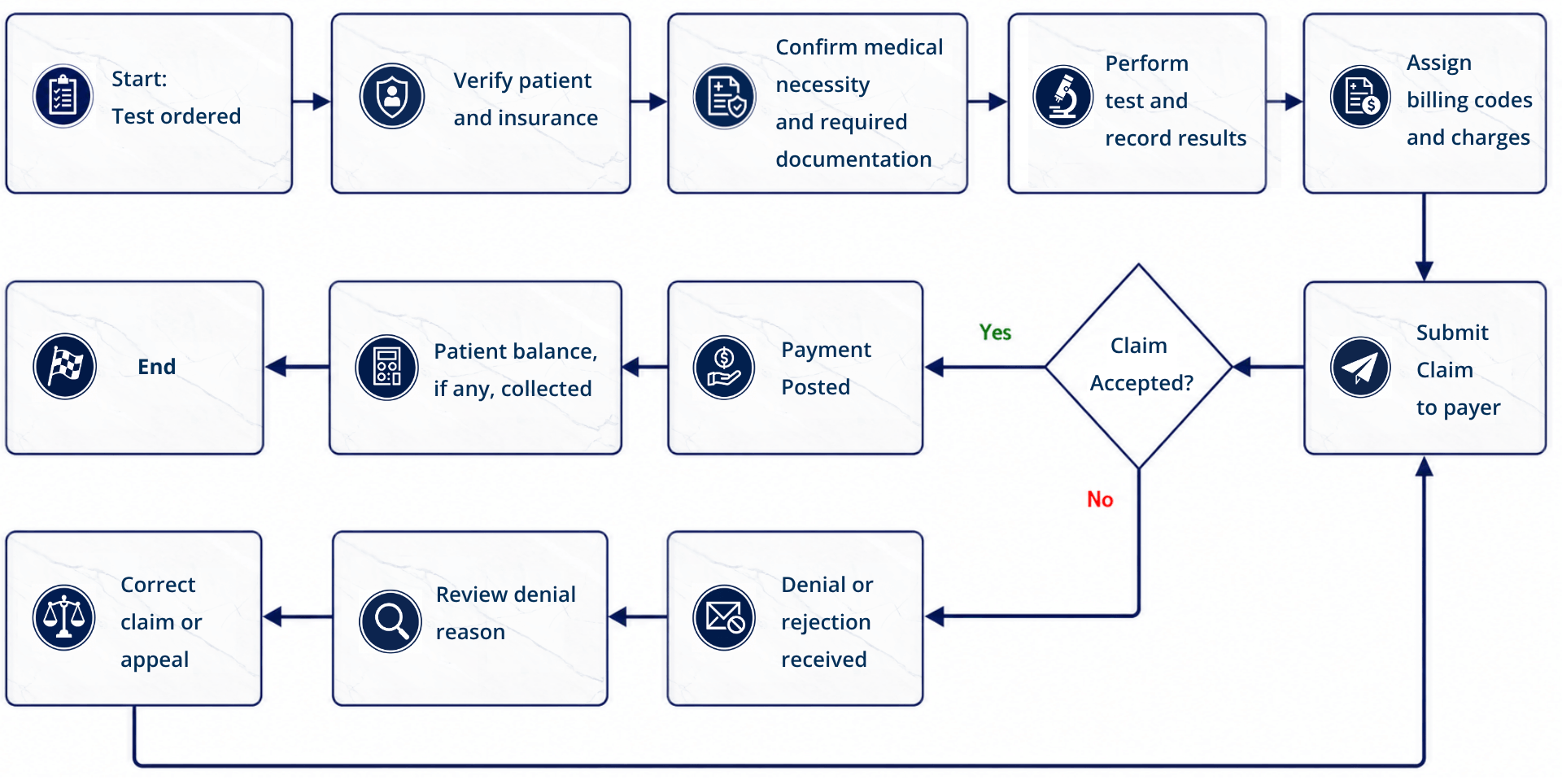
Here’s what each step means:

1. Verify patient and insurance:
You need to confirm eligibility, coverage, and authorization rules before billing the test.

2. Confirm medical necessity and documentation:

3. Assign billing codes and charges:

4. Submit claim to payer:

5. Review denial reason:
If the claim is rejected, you have up to 180 days (6 months) to fix missing data, coding, or documentation issues and resubmit. The appeal process may take 30 to 60 days, sometimes longer.
What are the key pitfalls of lab reimbursements?
Most labs think that when they perform the tests and submit a claim, that’s it. You get reimbursed. However, the truth is, reimbursement relies heavily on whether the documentation and billing match what was actually performed.
That’s why the key pitfalls of reimbursements are the following:
What should you focus on?
1. Strengthen front-end insurance and authorization checks.
2. Standardize documentation and billing review before claims go out.
4. Keep billing rules up to date as payer policies and fee schedules change.
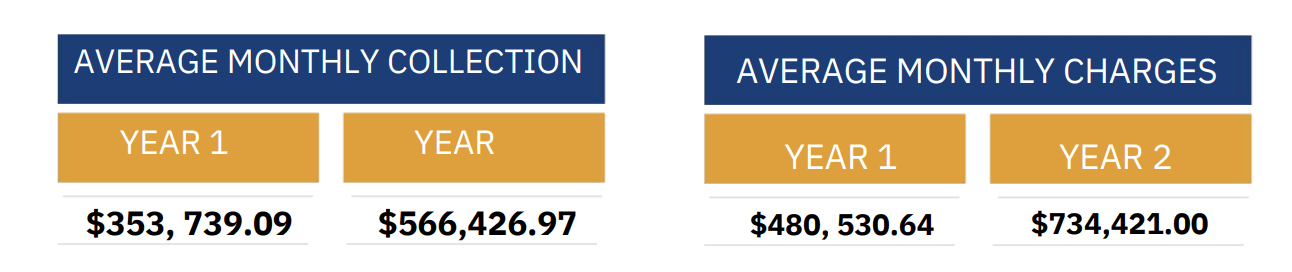
Take a look at our client, a Diagnostic Lab, which was empowered by Synapse through actionable strategies aligned with these focus areas.
Simple Lab Billing for Best Results with Synapse
With Synapse, you’ll achieve a clearer view of your operations and access vital data for benchmarking and regulatory reports. Since we figured out that clients deserve high-quality, transparent services and a personalized experience, our competitors are missing out on higher collection rates.
Join our clients in having the highest collection rates.
About Us
Synapse Lab Billing solutions provides end-to-end laboratory billing solutions designed to align with your operational and financial goals. We help laboratories improve visibility across the billing cycle, strengthen compliance reporting, and reduce revenue leakage through more structured and data-driven processes.
Sources:
E Jurinic, A-206 Exploring the Surge in Clinical Laboratory Inflation: A Comprehensive Review, Clinical Chemistry, Volume 70, Issue Supplement_1, October 2024, hvae106.204,
https://doi.org/10.1093/clinchem/hvae106.204
Clinical Laboratory Reimbursement in the United States – ASCLS. (2022, November 15). ASCLS.
https://ascls.org/clinical-laboratory-reimbursement-in-the-united-states/
Clinical labs hope to head off looming Medicare cuts. Retrieved from
https://www.msn.com/en-us/health/other/clinical-labs-hope-to-head-off-looming-medicare-cuts/ar-AA1TUzeG
Has Your Health Insurer Denied Payment for a Medical Service? You Have a Right to Appeal | CMS. (n.d.). Www.cms.gov.
https://www.cms.gov/CCIIO/Resources/Fact-Sheets-and-FAQs/appeals06152012a
Reimbursement & Coverage – American Clinical Laboratory Association. (n.d.). Www.acla.com.
https://www.acla.com/reimbursement-coverage/
Starolis, M. W., Kapoor, H., Jurcic Smith, K. L., Liesman, R. M., & Zenefski, D. R. (2025). The laboratory billing process and its applications to molecular microbiology testing: guidance for laboratorians. Journal of Clinical Microbiology, 63(10).
https://doi.org/10.1128/jcm.00666-25