
Why Lab Billing Is Becoming a Strategic Pillar of Healthcare Operations

The U.S. clinical laboratory industry continues to grow rapidly, with an expected reach of up to USD 16.18 billion by 2034. This growth is driven by rising demand for diagnostic testing, expanded preventive healthcare services, and the increasing complexity of modern laboratory testing.
As laboratories process higher testing volumes and more advanced diagnostics, billing operations are becoming more complicated and more important. Lab billing is no longer just an administrative task completed after testing. It now plays a direct role in revenue performance, compliance management, reimbursement accuracy, and operational efficiency.
Today, even small lab billing mistakes can lead to denied claims, delayed reimbursements, compliance risks, and major revenue loss across high-volume laboratory operations.
This guide explores why lab billing has become a critical part of healthcare operations and what laboratories can do to strengthen billing accuracy, compliance, and financial performance.
Key Takeaways
The clinical laboratory industry continues to grow due to higher demand for diagnostic testing and healthcare services.
High-performing laboratories rely on structured billing systems and standardized workflows to reduce denials and revenue leakage.
Inside, you will learn about:
Why Lab Billing Is Critical Today
Clinical laboratory testing represents only about 2%–3% of total U.S. healthcare spending, yet it plays a disproportionately large role in patient care, informing up to 60%–70% of clinical decisions.
This creates a unique challenge for laboratory billing operations.
Laboratories manage extremely high testing volumes while operating under strict payer rules, documentation requirements, and coding standards. Even though individual tests may have relatively low reimbursement values, billing errors across thousands of claims can quickly create a significant financial impact.
To understand the scale, consider this: A 1% billing error rate in 1,000 claims means 10 denied or delayed claims.
Now multiply that across real-world laboratory volumes, often 10,000, 50,000, or more claims per cycle, and even small inconsistencies quickly translate into meaningful revenue leakage.
Several factors make laboratory billing particularly vulnerable to inefficiencies:
Large testing volumes that amplify small errors
Complex coding requirements
Strict medical necessity rules
High compliance sensitivity
In this environment, even small billing mistakes can create bigger problems over time. With more than 14 billion lab tests performed annually in the United States, even minor inaccuracies can lead to substantial operational strain, delayed reimbursements, and lost revenue opportunities.
Why Billing Has Moved to the Center of Operations

1. Increased payer scrutiny.
Payers are enforcing stricter billing and reimbursement requirements than ever before. Laboratories are now expected to meet higher standards for:
Medical necessity
Many review systems are increasingly automated, making billing inaccuracies easier to detect and more likely to result in denials or audits.

2. Diagnostic complexity increased dramatically.
The rise of genetic testing, molecular diagnostics, and multi-analyte panels has made laboratory billing far more complicated.
These advanced tests often involve:

3. High-volume billing amplifies risk.
Laboratories process enormous numbers of claims every year, with over 14 billion lab tests performed annually in the U.S. Because of this scale, even small billing mistakes can create major operational and financial problems.
To put it simply: If you are processing 1,000 claims and only 10 are wrong, that is already 10 reimbursements lost or delayed.
This impact extends beyond reimbursement delays. Billing breakdowns can also affect workflow efficiency, payer relationships, compliance reporting, and long-term financial stability.
Together, these shifts have moved lab billing closer to the core of healthcare operations.
What High-Performing Labs Do Differently
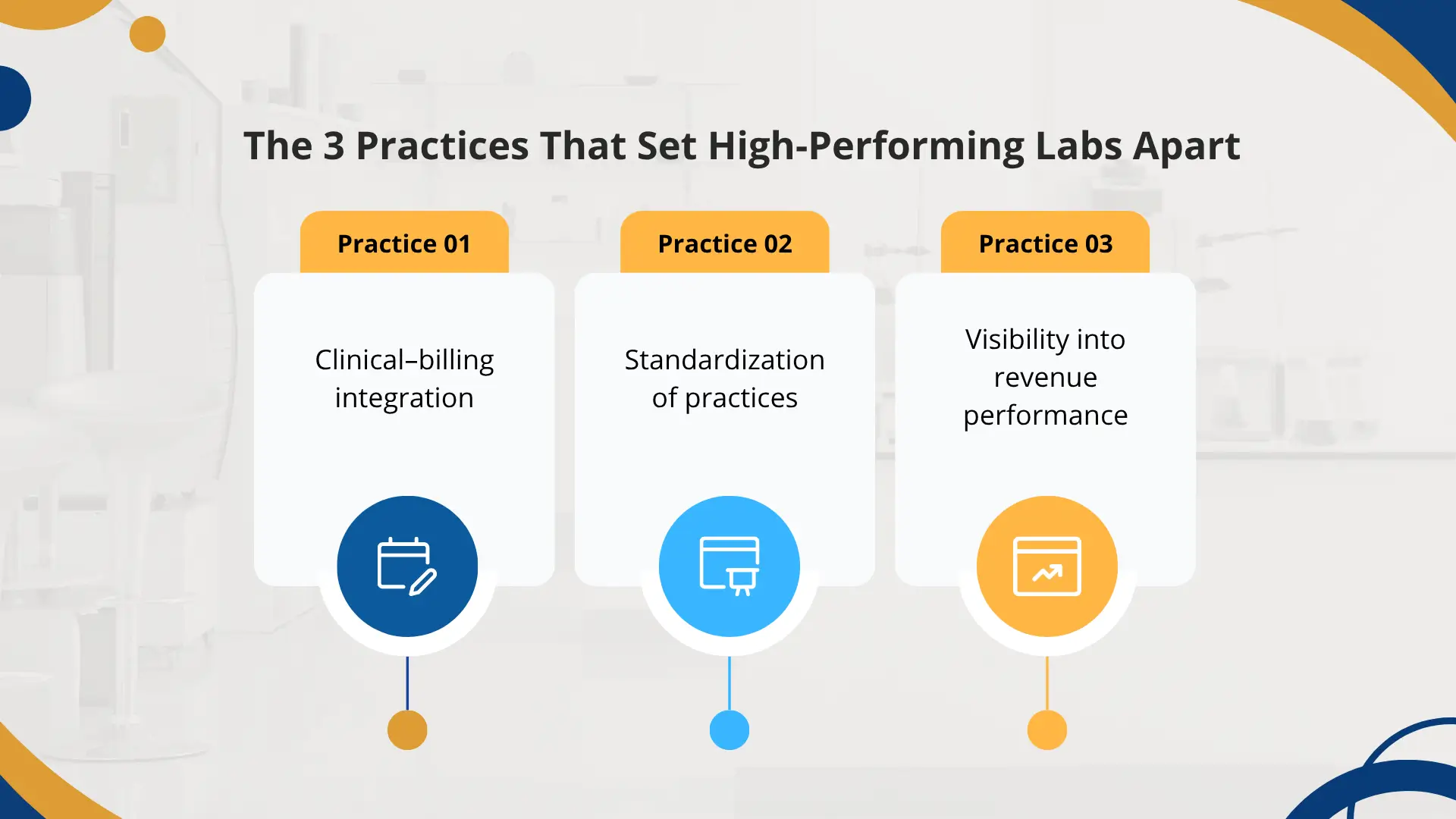
The most successful laboratories are not simply focused on increasing testing volume. They focus on building billing systems that connect clinical documentation, coding accuracy, operational workflows, and reimbursement management into one coordinated process.
Instead of treating billing as a separate department, high-performing laboratories integrate billing directly into day-to-day operations.
Three key patterns consistently stand out.

1. Clinical–billing integration.
High-performing laboratories constantly update and closely align billing processes with clinical workflows. Documentation, diagnosis selection, and coding requirements are built directly into test ordering and reporting procedures. This reduces the risk of missing information that could lead to claim denials or reimbursement delays.

2. Standardization of processes.
One of the most common drivers of claim denials is coding errors and missing CPT/ICD codes.
To address this, high-performing labs ensure consistent internal rules for the following:
Test ordering
Coding
Documentation follow
Consistent internal rules rather than individual interpretation help reduce variability and improve billing accuracy across the organization.

3. Visibility into revenue performance.
Consistent internal rules rather than individual interpretation help reduce variability and improve billing accuracy across the organization.
They track:
Denial trends
Documentation gaps
Instead of reacting only after claims are denied, these laboratories use billing data as an operational feedback system to identify problems early and improve overall performance.
For these high-performing labs, billing is not reactive. It functions as a feedback system for clinical and operational performance.
Case Study: Synapse Diagnostic Lab Client
To understand how clinical–billing alignment translates into real-world financial performance, let’s look at a case study from a Synapse Diagnostic Lab client. The laboratory was experiencing high testing volume, but financial performance was not keeping pace.
Key challenges included:
Inconsistent claim approvals across payers
Misalignment between clinical documentation and billing requirements
Although testing output remained stable, the laboratory experienced revenue leakage because clinical information was not consistently translated into accurate claims.
Synapse implemented a structured billing framework designed to improve alignment between clinical documentation and reimbursement workflows.
Improved clinical–billing matching
Clinically informed billing review
Faster payer communication
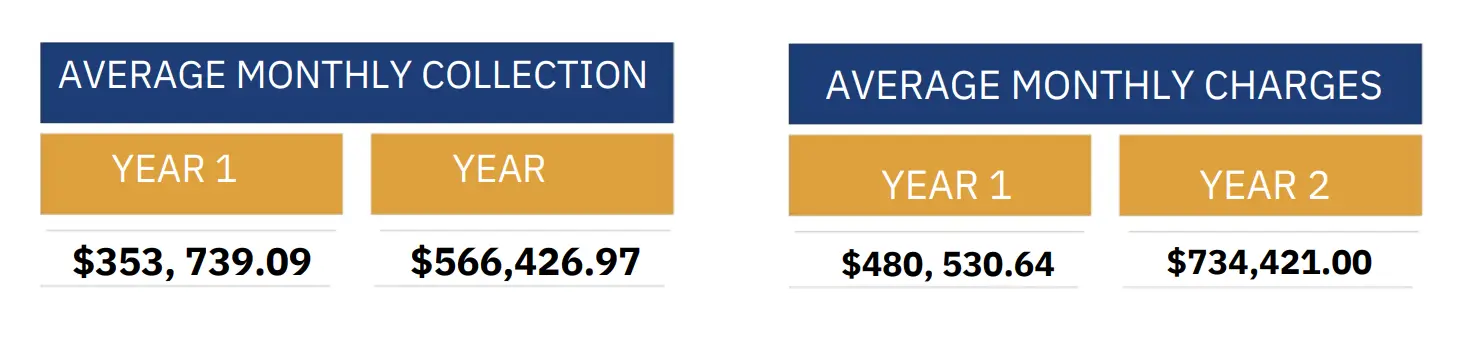
Average Monthly Collections
- Year 1: $353,739.09
- Year 2: $566,426.97
Bring Clarity to Lab Billing in a Complex System
As diagnostic testing continues to grow in complexity and scale, laboratory billing is becoming one of the most important drivers of financial stability and operational performance.
Strong billing systems help laboratories reduce denials, improve reimbursement accuracy, strengthen compliance, and maintain healthier revenue cycles.
At Synapse Lab Billing, we help laboratories bridge the gap between clinical operations and revenue integrity—ensuring that billing systems are built for accuracy, compliance, and scale.
Explore how your laboratory can improve billing performance and operational efficiency.
About Us
Synapse Lab Billing solutions provides end-to-end laboratory billing solutions designed to align with your operational and financial goals. We help laboratories improve visibility across the billing cycle, strengthen compliance reporting, and reduce revenue leakage through more structured and data-driven processes.
Sources:
Payer Audits and Payer Recoupments; Lifted from
https://www.massmed.org/Continuing-Education-and-Events/Online-CME/Courses/Payer-Audits-and-Payment-Recoupments/Payer-Audits-slides-(pdf)/
Why Is Medical Billing for Labs So Complex?; Lifted from
https://www.collaboratemd.com/blog/why-is-medical-billing-for-labs-so-complex/
US Clinical Laboratory Services Market Size to Reach USD 16.18 Billion by 2034; Lifted from
https://www.biospace.com/press-releases/u-s-clinical-laboratory-services-market-size-to-reach-usd-16-18-billion-by-2034
Clinical Standardization Programs; Lifted from
https://www.cdc.gov/clinical-standardization-programs/about/index.html
US Healthcare Denial Rates Reimbursement Statistics; Lifted from
https://www.aptarro.com/insights/us-healthcare-denial-rates-reimbursement-statistics
The Revenue Cycle of the Future; Lifted from
https://www.hfma.org/revenue-cycle/the-revenue-cycle-of-the-future-ai-boom-and-workflow-redesigns-accelerate-rev-cycle-transformation/